Laser Application Solutions

Laser Application Solutions

Forty towers, two ridges, one very long walk. The circuit is a 220 kV°REF line running 32 kilometres°REF across two ridges and a river crossing — 98 towers°REF. A walking patrol covers 3–5 kilometres a day°REF per team, in terrain where a single tower can take ninety minutes to reach. Add climbing for close inspection and the same circuit occupies two to three weeks°REF, several crews, and a substantial amount of risk. Now the same circuit has to be inspected twice a year instead of once, the vegetation on the eastern span is close to clearance limits, and last week's storm left the operator with no idea which spans took damage. This is the operating reality for most grid owners today: more kilometres, fewer crews, and a tolerance for outages that approaches zero.

Why the traditional patrol no longer scales.

  • Access dominates the cost. In mountainous, wetland or river-crossing terrain, most of the working day is spent getting to the asset, not inspecting it.

  • Climbing is inherently risky. Every tower ascent is a work-at-height entry on a live circuit. The industry has spent thirty years trying to reduce these entries, not increase them.

  • Close inspection is outage-dependent. Detailed visual and thermal work on energised assets is constrained, and de-energising a circuit to look at it costs more than the inspection.

  • Thermal defects are invisible without a thermal sensor. A heating clamp or a failing splice looks completely normal to the naked eye and to a standard camera.

  • Data is not comparable. Two inspectors describe the same insulator differently. Photos live on personal devices without coordinates. Year-on-year condition trending is guesswork.

  • Nobody can answer "where is the damage?" after a storm. Damage assessment takes days, and restoration crews are dispatched on partial information.

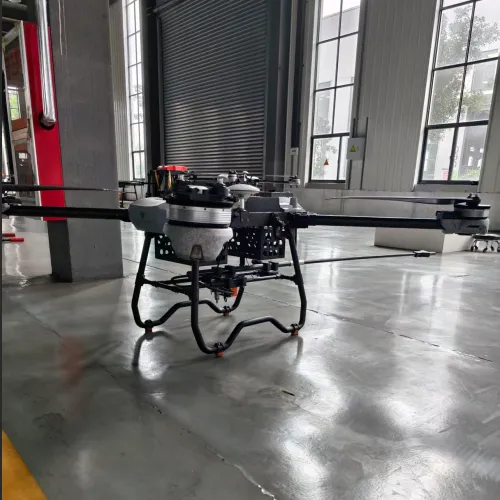
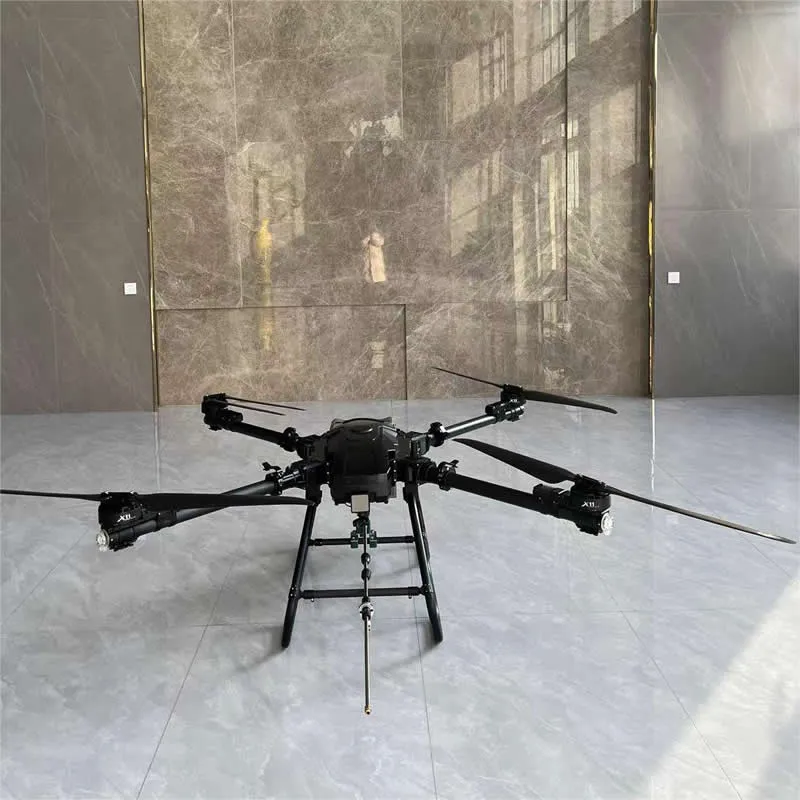
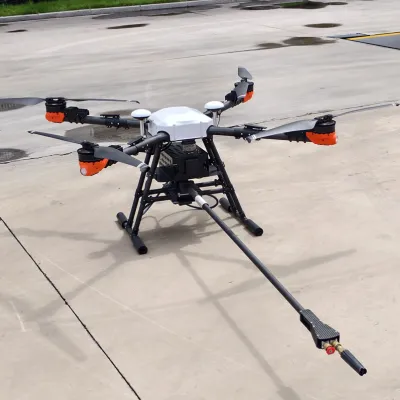
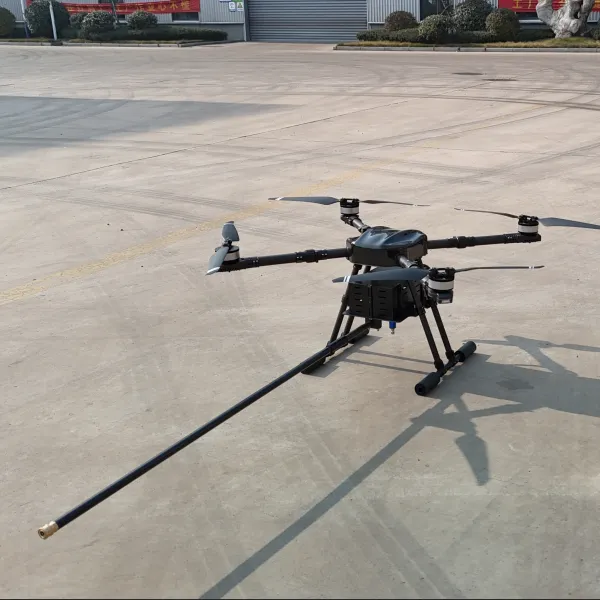
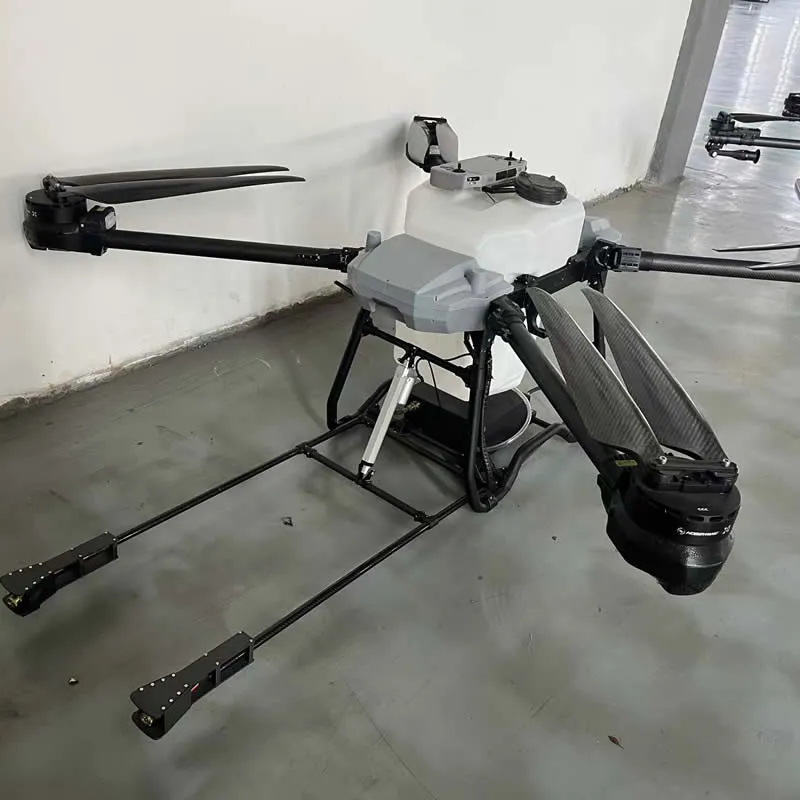
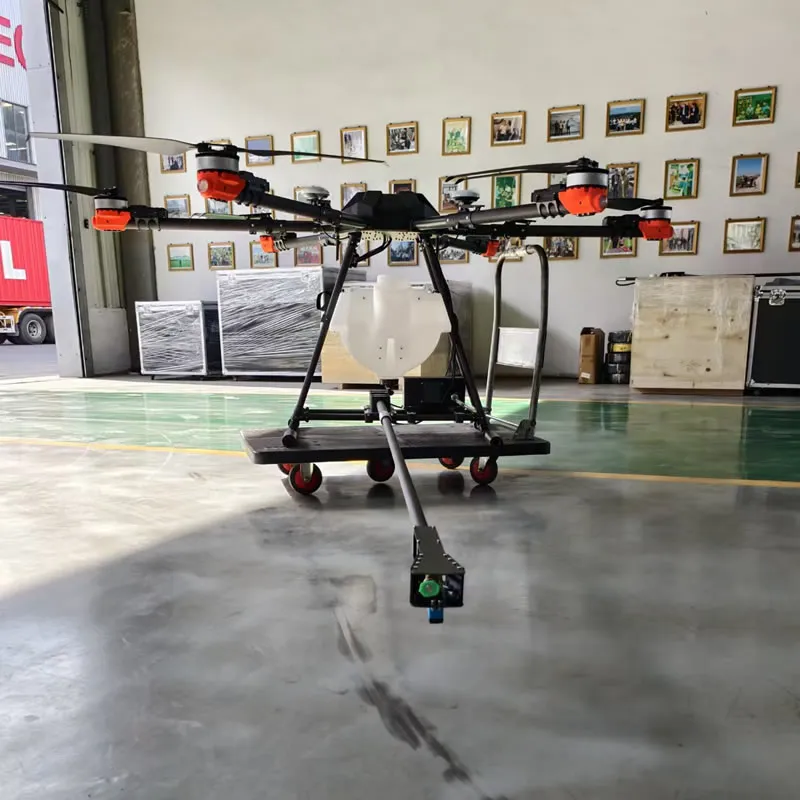
What the aircraft does. Rongyixin's inspection UAV flies the corridor itself. RTK-guided waypoint routes place the aircraft at a repeatable position beside each tower; it captures geo-tagged visual and thermal imagery in a fixed sequence, then returns. 25–40 kilometres per day°REF for a two-person crew, with no climbing and no outage°REF. The output is not a folder of photographs. It is a per-tower record with defect flags, severity grading and coordinates, ready to import into the maintenance system as work orders.

Capabilities that matter to an asset manager.

  • Repeatable geometry. RTK waypoint flight returns to the same standoff position and camera angle on every inspection cycle. The image taken this year can be laid directly over last year's — which is what turns a photo archive into a condition trend.

  • Two sensors, one pass. A 30×°REF optical zoom resolves insulator sheds, broken conductor strands, corrosion and bird nests; a 640 × 512°REF thermal sensor reads joint and clamp temperatures, catching resistive heating long before it becomes a failure.

  • Measurement, not just imaging. Optional LiDAR supports vegetation clearance measurement, conductor sag and ground-clearance analysis — the three things that most often drive unplanned outages.

  • AI pre-screening. Automatic flagging of insulator damage, broken strands, foreign objects and hot spots, at roughly 85–95%°REF detection accuracy, sorting thousands of images so the engineer reviews the few that matter.

  • Safe near energised assets. EMI-resistant flight control and a stabilised 5–10 metre°REF standoff from conductors allow inspection of live circuits.

  • Structured capture. Tower-by-tower, position-by-position archiving, geo-tagged and time-stamped, enabling defensible regulatory reporting.

  • Reports that become work orders. Severity grading, evidence images, coordinates and export formats for the maintenance system.

A day on the circuit.

  1. Planning. Tower coordinates and the corridor route are loaded; inspection points are set per tower type and voltage level.

  1. Automated flight. The crew launches from a roadside point and the aircraft works the corridor, holding standoff and capturing each tower in sequence. Obstacle sensing handles the span over the river.

  1. Triage. On return, AI pre-screens the image set and flags priority defects.

  1. Engineering review. Two hours of desk work replaces two weeks of walking; findings are graded and scheduled.

  1. Verification. After repair, a short confirmation flight closes the work order with a matching image.

What it means for the bottom line.

Measure

Walking / climbing patrol

Rongyixin UAV

Coverage per day

3–5 km°REF

25–40 km°REF

Cost per km inspected

baseline

−40% to −60%°REF

Work-at-height entries

per tower

eliminated

Outage required

often

none

Defect detection rate

baseline

+30% to +50%°REF

Data consistency

manual, variable

standardised, geo-tagged

Post-storm assessment

2–3 days°REF

6 hours°REF

Where it fits. Transmission lines 110 kV and above°REF · distribution networks and substations · railway catenary · oil, gas and pipeline corridors · wind-farm collector lines · mountainous, wetland and river-crossing spans · post-storm, post-flood and post-earthquake damage assessment.

Getting started. Send us voltage level, corridor length, tower count and terrain profile. We will return a coverage model, a sensor recommendation (visual, thermal, LiDAR), and a cost-per-kilometre comparison against your current patrol method.

Reference specification (confirm before publishing): Coverage per day 25–40 km · Optical zoom 30× · Thermal sensor 640 × 512 · Optional payload LiDAR for clearance and sag analysis · AI detection accuracy 85–95% · Conductor standoff 5–10 m · Guidance RTK waypoint corridor flight · EMI resistance rated for live-line environment · Output geo-tagged defect list with severity grading.


Product Inquiry


Please leave your message, we will contact you quickly after receiving it, thank you for your support!


هل لديك أسئلة حول الأحمال أو الأوقات المحددة أو التخصيص؟ اتصل بفريقنا أو أرسل استفسارًا — سنرد خلال يوم عمل واحد بجواب واضح وعملي.


Copyright © 2216-2026 Jining Rongyixin Trading Co., Ltd. All rights reserved

Leave your message

If you have any suggestions or questions for us, please feel free to contact us!

We use cookie to improve your online experience. By continuing to browse this website, you agree to our use of cookie.

Cookies

Please read our Terms and Conditions and this Policy before accessing or using our Services. If you cannot agree with this Policy or the Terms and Conditions, please do not access or use our Services. If you are located in a jurisdiction outside the European Economic Area, by using our Services, you accept the Terms and Conditions and accept our privacy practices described in this Policy.
We may modify this Policy at any time, without prior notice, and changes may apply to any Personal Information we already hold about you, as well as any new Personal Information collected after the Policy is modified. If we make changes, we will notify you by revising the date at the top of this Policy. We will provide you with advanced notice if we make any material changes to how we collect, use or disclose your Personal Information that impact your rights under this Policy. If you are located in a jurisdiction other than the European Economic Area, the United Kingdom or Switzerland (collectively “European Countries”), your continued access or use of our Services after receiving the notice of changes, constitutes your acknowledgement that you accept the updated Policy. In addition, we may provide you with real time disclosures or additional information about the Personal Information handling practices of specific parts of our Services. Such notices may supplement this Policy or provide you with additional choices about how we process your Personal Information.


Cookies

Cookies are small text files stored on your device when you access most Websites on the internet or open certain emails. Among other things, Cookies allow a Website to recognize your device and remember if you've been to the Website before. Examples of information collected by Cookies include your browser type and the address of the Website from which you arrived at our Website as well as IP address and clickstream behavior (that is the pages you view and the links you click).We use the term cookie to refer to Cookies and technologies that perform a similar function to Cookies (e.g., tags, pixels, web beacons, etc.). Cookies can be read by the originating Website on each subsequent visit and by any other Website that recognizes the cookie. The Website uses Cookies in order to make the Website easier to use, to support a better user experience, including the provision of information and functionality to you, as well as to provide us with information about how the Website is used so that we can make sure it is as up to date, relevant, and error free as we can. Cookies on the Website We use Cookies to personalize your experience when you visit the Site, uniquely identify your computer for security purposes, and enable us and our third-party service providers to serve ads on our behalf across the internet.

We classify Cookies in the following categories:
 ●  Strictly Necessary Cookies
 ●  Performance Cookies
 ●  Functional Cookies
 ●  Targeting Cookies


Cookie List
A cookie is a small piece of data (text file) that a website – when visited by a user – asks your browser to store on your device in order to remember information about you, such as your language preference or login information. Those cookies are set by us and called first-party cookies. We also use third-party cookies – which are cookies from a domain different than the domain of the website you are visiting – for our advertising and marketing efforts. More specifically, we use cookies and other tracking technologies for the following purposes:

Strictly Necessary Cookies
These cookies are necessary for the website to function and cannot be switched off in our systems. They are usually only set in response to actions made by you which amount to a request for services, such as setting your privacy preferences, logging in or filling in forms. You can set your browser to block or alert you about these cookies, but some parts of the site will not then work. These cookies do not store any personally identifiable information.

Functional Cookies
These cookies enable the website to provide enhanced functionality and personalisation. They may be set by us or by third party providers whose services we have added to our pages. If you do not allow these cookies then some or all of these services may not function properly.

Performance Cookies
These cookies allow us to count visits and traffic sources so we can measure and improve the performance of our site. They help us to know which pages are the most and least popular and see how visitors move around the site. All information these cookies collect is aggregated and therefore anonymous. If you do not allow these cookies we will not know when you have visited our site, and will not be able to monitor its performance.

Targeting Cookies
These cookies may be set through our site by our advertising partners. They may be used by those companies to build a profile of your interests and show you relevant adverts on other sites. They do not store directly personal information, but are based on uniquely identifying your browser and internet device. If you do not allow these cookies, you will experience less targeted advertising.

How To Turn Off Cookies
You can choose to restrict or block Cookies through your browser settings at any time. Please note that certain Cookies may be set as soon as you visit the Website, but you can remove them using your browser settings. However, please be aware that restricting or blocking Cookies set on the Website may impact the functionality or performance of the Website or prevent you from using certain services provided through the Website. It will also affect our ability to update the Website to cater for user preferences and improve performance. Cookies within Mobile Applications

We only use Strictly Necessary Cookies on our mobile applications. These Cookies are critical to the functionality of our applications, so if you block or delete these Cookies you may not be able to use the application. These Cookies are not shared with any other application on your mobile device. We never use the Cookies from the mobile application to store personal information about you.

If you have questions or concerns regarding any information in this Privacy Policy, please contact us by email at . You can also contact us via our customer service at our Site.